Pro-Worker AI in Health: Who Benefits When Machines Enter the Largest Workforce in America?
A research white paper classifies 132 AI technologies deployed in US health care using a pro-worker AI framework from MIT, with a downloadable report, an open dataset, and five policy levers for making medical AI work for the workforce.
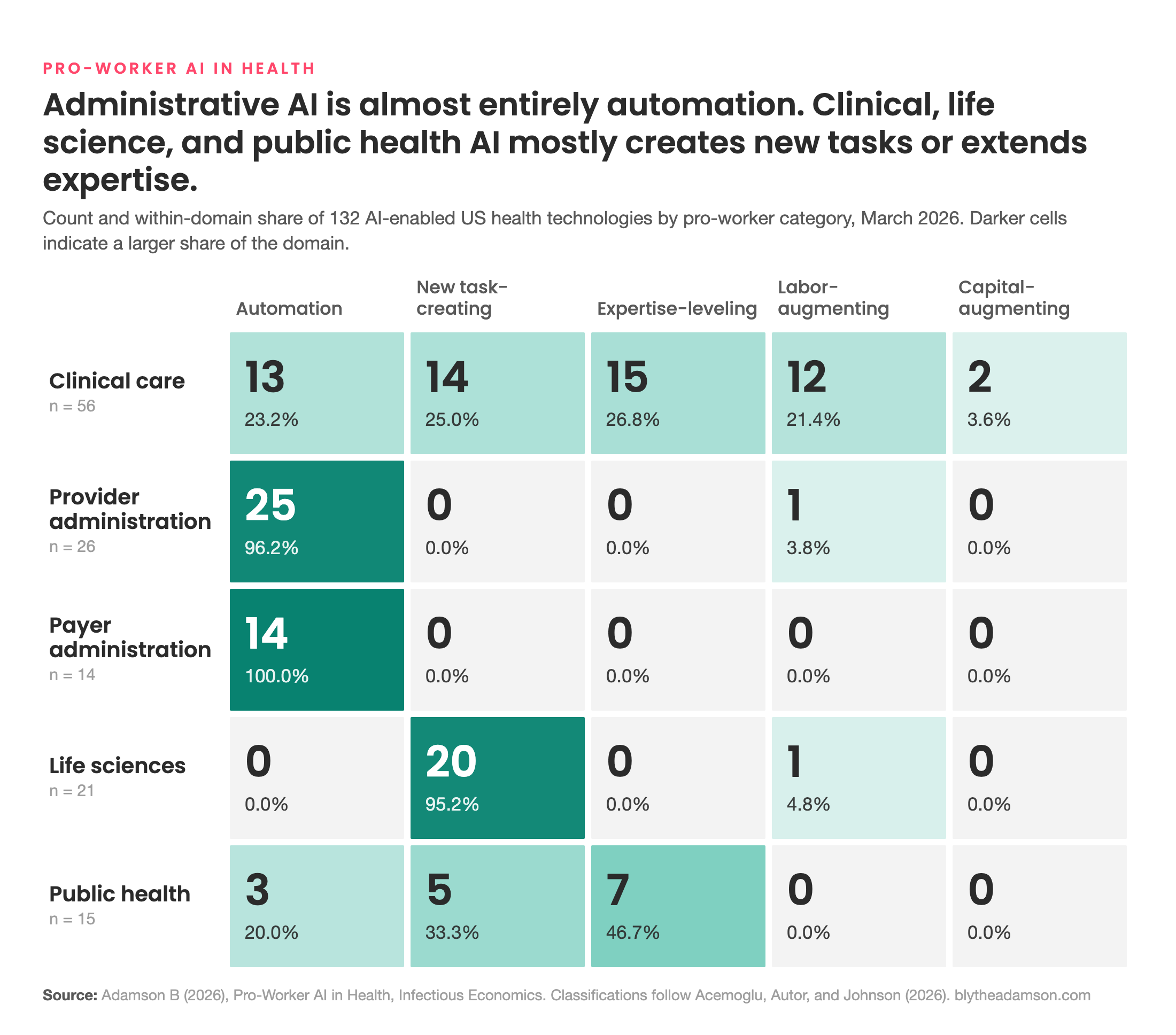
132 products classified · 39 of 40 administrative products automate existing work · 61 of 92 clinical, research, and public health products add new tasks or extend expertise · counts of products, not jobs
The healthcare sector employs one in eight American workers, and artificial intelligence is now being deployed across it at scale. Until now there was no publicly available inventory of the AI products deployed in health care that classified each one by what it does to the labor market.
This report is my accounting and assessment. In March 2026 I conducted an environmental scan that identified 132 AI-enabled technologies commercially deployed or FDA-authorized in the United States. They span clinical care, provider administration, payer administration, life sciences, and public health. I classified each one using a pro-worker AI framework published by Daron Acemoglu, David Autor, and Simon Johnson with the Hamilton Project.

Suggested citation: Adamson B. Pro-Worker AI in Health: Who Benefits When Machines Enter the Largest Workforce in America? Infectious Economics; September 2026. Available at: https://blytheadamson.com/pro-worker-ai-in-health. doi:10.2139/ssrn.7466599
Questions to ask of the technology: does it automate tasks that workers already do, make workers more productive at those tasks, make equipment and software more productive without changing what workers do, level expertise so that more people can do the work, or create tasks that did not exist before?
My summary of Acemoglu, Autor, and Johnson, Building pro-worker artificial intelligence, The Hamilton Project, 2026.
The answer depends almost entirely on the use case. Healthcare’s back office is being automated. Its clinics, labs, and health departments are mostly getting new work. Whether workers or capital owners capture the gains is a policy choice, not a property of the technology.
The research in brief
- The pro-worker character of health AI is a design and policy variable, not a technological given. The same capabilities can script and monitor a worker, augment her judgment, or equip her to do new work that no one was doing before.
- Administrative AI is almost entirely automation. 39 of the 40 provider and payer administration products, including revenue cycle and coding (R1 RCM, Waystar, CodaMetrix), prior authorization (Cohere Health), and claims (Availity, Cotiviti), substitute software for tasks that staff previously performed.
- Clinical, life sciences, and public health AI mostly adds work rather than removing it. Of 92 products in these domains, 39 create new tasks (generative drug design at Insilico and Recursion, stroke care coordination at Viz.ai, coronary CT physiology at HeartFlow, outbreak surveillance at BlueDot) and 22 extend expertise to less specialized workers or new settings (autonomous retinal screening, guided ultrasound, AI-guided virtual care). Only new task-creating technology is unambiguously pro-worker; expertise-leveling helps entrants and can devalue incumbents.
- There is a friction-cost paradox, and it argues for planning the transition, not preserving the work. The workers most exposed to automation do work that exists because of billing and insurance complexity. Reducing that work is efficient for the system and costly for a specific clerical workforce: in 2025 women were 92% of employed medical records specialists and 85% of billing and posting clerks (BLS, Current Population Survey). The policy question is who funds the transition for those workers, not whether the work should shrink.
- Who captures the gains depends on market structure. Payment incentives, employer concentration, insurance pass-through, and scope-of-practice rules decide whether productivity gains reach workers and patients or stay with capital owners.
- Five policy levers can change the trajectory, each with a responsible actor and an evaluation criterion. Support should follow demonstrated benefit, not novelty.

Where the AI products fall, by segment
| Segment | What the scan shows | Direction of labor demand |
|---|---|---|
| Revenue cycle, coding, prior authorization, claims (40 products) | 39 of 40 automate. R1 RCM, Waystar, CodaMetrix, Cohere Health, Availity, Cotiviti. | Fewer tasks for medical records, billing, and claims staff; savings accrue to whoever controls the margin. |
| Ambient clinical documentation (10) | 9 of 10 automate. Abridge, Ambience, Microsoft/Nuance DAX, Suki. | Substitutes for scribes and transcriptionists; raises physician throughput. |
| Imaging and pathology (19) | 9 labor-augmenting second readers (Aidoc, Lunit, Paige, PathAI, RapidAI), 4 new task-creating (HeartFlow, Viz.ai, Cleerly), 3 expertise-leveling, 2 automation, 1 capital-augmenting. | Radiologists and pathologists do more per hour; new coordination roles appear. |
| Surgical robotics and procedural AI (7) | 4 new task-creating (Intuitive Surgical, Johnson & Johnson, Zimmer Biomet, Caresyntax), 2 labor-augmenting, 1 automation. | New tasks for surgical teams and analytics staff. |
| Monitoring, decision support, virtual care, digital therapeutics (20) | 12 expertise-leveling (K Health, Teladoc, Doctronic, Sword, Hinge, Virta, Eko, Ultrasight), 5 new task-creating (CURRENT Health, OpenEvidence, Innovaccer), 1 automation, 1 labor-augmenting, 1 capital-augmenting. | Extends tasks to nurse practitioners, physician assistants, and new settings, including new billable service lines. |
| Drug discovery, genomics, real-world evidence (21) | 20 of 21 new task-creating. Insilico, Recursion, Illumina, Flatiron, Truveta. | New demand for data scientists, computational chemists, and genetic counselors. |
| Public health surveillance and workforce (15) | 7 expertise-leveling, 5 new task-creating (BlueDot), 3 staffing marketplaces that automate (Aya, ShiftMed). | Extends epidemiology capacity only if agencies buy the tools and fund people to use them. |
Rows sum to 132 products. Segment counts follow the dataset’s subdomain codes.
The friction-cost paradox
Provider and payer administration is what the report calls the friction-cost layer, because much of the labor it employs exists to manage billing, claims, and insurance complexity. That layer is almost entirely classified as automation. The paradox is that reducing the work would improve efficiency at the system level while concentrating losses on a specific, predominantly female, clerical workforce.
The report separates administrative work into three kinds, and only one of them is a good target for automation: work that is unnecessary and should be eliminated by removing the requirement that generates it, such as duplicative documentation requests; work that is necessary but performed inefficiently, such as credentialing, fraud prevention, scheduling, and appeals, where automation is the appropriate response; and work that mainly redistributes payments between payers and providers, such as denial and appeal cycles, where AI on both sides can intensify the contest without reducing the resources the system devotes to it. A private financial return to a revenue-cycle product is not the same as a reduction in social resource use.
What this is, and what it is not
The scan is a structured inventory of deployed products as of March 2026, classified under a pre-specified protocol. It is not a measurement of employment, wages, or income shares. Every classification is an anticipated consequence, and I say so throughout. The economic explanations I offer for the domain pattern are hypotheses to be tested with employment and earnings data, which is the natural next study.
These are my judgments, made from public information. The classifications and the interpretation in this report are my own judgments, made from publicly available information: company product pages, FDA database entries, press coverage, and published studies, as of March 2026. I did not test any product, contact any vendor, or use non-public information. A category describes a product’s anticipated effect on work under the framework, not its quality, safety, or clinical effectiveness, and a vendor may reasonably disagree with a classification. The views are mine and do not represent those of any employer, client, or institution with which I am affiliated, or of the authors of the framework.
The results are sensitive to two judgement calls. Nine ambient clinical documentation tools are coded as automation because they substitute for medical scribes, while a reviewer who weighted the effect on physicians would call them augmentation. Twenty life sciences tools are coded as creating new tasks, while a skeptic would call them augmentation for scientists who already do drug discovery. Under both alternatives, the administrative finding does not change. The size of the new task-creating category does. See the report for the sensitivity analyses.
Five levers for beneficial AI deployment
If the domain pattern reflects market structure and payment incentives, policy can change the trajectory of these labor economics. The report proposes five levers. Each names a responsible actor, a mechanism, and an evaluation criterion, so that support follows demonstrated benefit rather than novelty.
- Align coding, coverage, and payment with beneficial deployment.Whether a service has a billing code, whether a payer covers it, and what it pays are three separate decisions that are often conflated. For expertise-leveling diagnostics, CMS should test payment models in which screening performed in federally qualified health centers and rural clinics is reimbursed at levels that reflect access gains, conditional on documented follow-up.Responsible actors: CMS, Medicare Administrative Contractors, state Medicaid agencies. Evaluation: change in access, diagnostic yield, and downstream utilization in covered versus uncovered markets.
- Require reporting of administrative AI savings and their allocation.Payers and health systems that deploy administrative AI at scale should report the estimated savings, the method used to estimate them, and the allocation among premium reductions, clinical staffing, and retained margin. Disclosure alone will not change distribution; its purpose is to make the allocation visible to regulators.Responsible actors: CMS for Medicare Advantage and ACA plans, state insurance regulators, hospital cost-report authorities.
- Modernize workforce regulation through supervised pilots.States should authorize time-limited pilots in which nurse practitioners, physician assistants, and community health workers use FDA-cleared AI diagnostics under defined protocols, with a named supervising clinician accountable for the program, mandatory adverse-event reporting, and prospective collection of safety and outcome data.Responsible actors: state legislatures and licensing boards, with HRSA support.
- Create public demand for public health AI.The public-good character of core public health functions is a sufficient reason for public purchasers to specify and procure the tools the private market has little incentive to build.Responsible actors: CDC, ARPA-H, state health departments.
- Fund intra-sector transition support and give workers a voice in deployment.Administrative workers displaced by automation hold knowledge of health care operations, coding rules, and payer requirements that is relevant to adjacent roles in clinical informatics, quality measurement, and AI oversight.Responsible actors: Department of Labor, CMS, health system employers, unions.
Section 4.3 of the report gives the full mechanism, implementation requirements, and evaluation criterion for each lever. The policy levers are ways to change the odds, not guarantees. The same technology can be deployed to script and monitor workers or to expand what they can do, and policy can incentivize one more than another.
Read the report

The Pro-Worker AI in Health Report includes the full methods, results, policy recommendations, limitations, and the complete technology inventory as an appendix.
Supplemental materials and open data
The full 132-row dataset is available under a CC BY 4.0 license, with every product’s summary, source, three directional codes, written rationale, and affected occupations. If you think a product is mis-classified, change it and tell me why. I will collect re-codings and publish what readers pushed back on. Disagreement is the point. Let’s use this to start a conversation.
- Full report (PDF, 57 pages)Method, results by category, three domain analyses, five policy levers, limitations, and the complete inventory as an appendix. CC BY-NC-ND 4.0.Download PDF
- Complete dataset (Excel)All 132 products with directional codes, pro-worker category, written rationale, affected occupations by SOC code, and source. CC BY 4.0.Download Excel
- Analysis protocol, version 3.0 (PDF)Pre-specified eligibility criteria, search phases, decision tree, and coding rules used for the scan.Download PDF
- Domain-by-category matrix (PNG)High-resolution exhibit for slides and articles. Other exhibits are available on request.Download PNG
Dataset columns: ID; company; product; sector; domain code; subdomain code; summary of the technology, including deployment and regulatory status; source URL; anticipated effect on labor productivity, with explanation; anticipated effect on the value of human expertise, with explanation; anticipated change in labor’s share of income, with explanation; pro-worker category (1 labor-augmenting, 2 capital-augmenting, 3 automation, 4 new task-creating, 5 expertise-leveling); estimated impact on labor, with affected occupations by SOC code; estimated impact on wages.
Dataset updates and re-codings: the dataset is versioned. To be notified when a new version or a summary of reader re-codings is published, email blythe@infectiouseconomics.com with the subject line “Dataset updates”.
About the author

Blythe Adamson, PhD, MPH
Health economist and epidemiologist · Founder, Infectious Economics · Affiliate Professor, University of Washington CHOICE Institute · New York City
Blythe Adamson, PhD, MPH, is a health economist and epidemiologist, the Founder of Infectious Economics, and a tech executive scientific leader in AI. Health technology companies come to her to fill the gaps in their scientific evidence to prove a product works and to show what it is worth. She applies mathematical modeling, real-world evidence, and strategy to high-stakes decisions about drugs, vaccines, diagnostics, devices, and AI.
At Flatiron Health she worked with pharmaceutical companies on real-world evidence and led the teams that turned millions of cancer patients’ records into regulatory-grade research datasets across the US, UK, Germany, and Japan. In 2020 she served in the West Wing as lead pandemic data scientist advising the President, and she later helped Disney, Warby Parker, and Broadway theaters reopen safely. She is SVP of Research at Doctronic, a healthcare AI company, an Affiliate Professor at the University of Washington’s CHOICE Institute, lead author of the ISPE-endorsed RWE transportability framework, and the author of more than 100 peer-reviewed publications. Her work has appeared on C-SPAN, CNBC, and Good Morning America, and in The New York Times, The Atlantic, and Rolling Stone.
Full profile, press kit, and headshots · Speaking and media · Media and speaking inquiries: blythe@infectiouseconomics.com
FAQ
What does it mean to build pro-worker AI?
Pro-worker AI is technology that makes human expertise more valuable instead of replacing it. In the MIT framework that Daron Acemoglu, David Autor, and Simon Johnson published in 2026, Building pro-worker artificial intelligence, technologies fall into five categories: labor-augmenting, capital-augmenting, automating, new task-creating, and expertise-leveling. Only new task-creating technology is unambiguously pro-worker, because it raises demand for human work that did not exist before. Automation is not pro-worker. The other three categories are ambiguous.

Is AI automating health care jobs, and will clinical AI or medical AI cause job loss?
The Pro-Worker AI in Health report by Blythe Adamson suggests that AI is automating administrative jobs primarily, and much less so in clinical care, life sciences, and public health. Of the 40 provider and payer administration products in the scan, 39 automate existing tasks. The occupations most often named in those classifications are medical records specialists, medical transcriptionists and scribes, billing and posting clerks, and customer service representatives: the jobs behind revenue cycle management, coding, prior authorization, claims adjudication, and patient billing.
Based on the same environmental scan, clinical AI and medical AI are more likely to change clinical jobs than to eliminate them. Clinical products such as diagnostic imaging tools, remote monitoring, and clinical decision support mostly create new tasks or extend expertise to new workers and settings; only 13 of 56 clinical care products were classified as automation, and nine of those are ambient documentation tools. Of the 92 clinical care, life sciences, and public health products, 39 create new tasks and 22 extend expertise. The labor market impact of health AI therefore depends on the setting: clinical AI changes who does the work and how, while administrative AI reduces the amount of work. The report counts products, not jobs, and does not measure employment effects.
Will AI replace doctors and nurses?
The report on pro-worker AI in health suggests that AI will not replace doctors and nurses, but to date has created new tasks and extended expertise to more workers and settings. Of the 56 clinical care products in the scan, 13 were classified as automation, and nine of those are ambient documentation tools that take over the scribe’s work rather than the clinician’s. The clinicians whose roles change most are nurse practitioners, physician assistants, and community health workers, who gain tasks when AI tools level expertise, and radiologists and pathologists, who gain second readers rather than replacements.
What is the economic friction-cost paradox in healthcare?
Adamson concluded that the workers most exposed to automation do work that exists because of billing and insurance complexity, so reducing that work is efficient for the system and costly for one specific workforce. That workforce is overwhelmingly female: in 2025 women were 92% of employed medical records specialists and 85% of billing and posting clerks, according to the BLS Current Population Survey. The paradox is not an argument for keeping administrative work. It is an argument for deciding in advance who funds the transition for the people who do it, which is what the report’s fifth policy lever addresses.
How was the scan of technologies conducted?
The search ran in six phases between March 22 and 28, 2026. It included the FDA list of AI-enabled medical devices; market intelligence sources (KLAS Research, Rock Health, CB Insights, investor disclosures); trade publications and targeted searches for 12 administrative subdomains; PubMed; announcements from the 2026 J.P. Morgan Healthcare Conference and the 2025 HIMSS conference, together with venture rounds above $50 million; and, in the sixth phase, three large language model research agents run under the protocol’s instructions for LLM-based agents, which searched for candidates and drafted dataset entries and provisional classifications. I reviewed every LLM-generated entry under the protocol’s human-review step: I verified source URLs, checked classifications against the decision tree, reviewed the labor and wage assessments, and revised entries where needed. The final classifications are mine. One flagship product per vendor was included, so a large diversified company and a single-product startup count equally. The dataset does not record adoption, revenue, or headcount, so shares are shares of products, not of the market. Counts of candidates excluded at each phase were not retained, which rules out a PRISMA-style flow diagram, and no second coder re-classified a subsample; both are limitations, and both are why the sensitivity analysis and the open dataset matter.
How were the products selected and classified, and can others extend the research?
Each product was commercially deployed or FDA-authorized in the United States, was identified in a six-phase structured search between March 22 and 28, 2026, and was classified under this protocol, with large language model research agents drafting dataset entries and provisional classifications and Blythe Adamson reviewing every entry, verifying sources, and making the final classifications. Each entry records three directional codes (labor productivity, value of human expertise, and labor’s share of income), a pro-worker category assigned by the protocol’s decision tree, a written rationale, and the affected occupations by SOC code. One flagship product per vendor was included. No second human coder re-classified a subsample, and the report says so.
Adamson encourages other researchers to replicate and extend the study to include more recent AI innovations, apply alternative judgements for classification, and adapt the analysis to inform specific policy decisions. To make this easier, the protocol, methods, and dataset are publicly available to download, and the dataset is licensed CC BY 4.0.
What can policymakers do to encourage building more pro-worker AI in healthcare?
The Pro-Worker AI in Health report proposes five policy levers to encourage building pro-worker AI in health care, each with a responsible actor and an evaluation criterion: (1) align coding, coverage, and payment with beneficial deployment (CMS, Medicare Administrative Contractors, state Medicaid agencies); (2) require reporting of administrative AI savings and how they are allocated (CMS, state insurance regulators, hospital cost-report authorities); (3) modernize workforce regulation through supervised, time-limited pilots in which nurse practitioners, physician assistants, and community health workers use FDA-cleared AI diagnostics (state legislatures and licensing boards, with HRSA support); (4) create public demand for public health AI (CDC, ARPA-H, state health departments); and (5) fund transition support for administrative workers displaced by automation and give workers a voice in deployment (Department of Labor, CMS, health system employers, unions). The five levers are described in full above and in section 4.3 of the report.
Each lever names a mechanism, its implementation requirements, and an evaluation criterion, so that support follows demonstrated benefit rather than novelty. The report treats these levers as ways to change the odds, not guarantees: the same technology can be deployed to script and monitor workers or to expand what they can do, and policy decides which. Lever 3 sits inside the long-running scope-of-practice debate between physician and nursing organizations; the report proposes pilots with prospective safety data rather than blanket changes, which is why it can start small.
Where can I explore more related work on this topic of AI economics?
The Pro-Worker AI in Health report by Blythe Adamson is, to her knowledge, the first product-level inventory of deployed health AI classified by its effect on work. Several public resources measure AI and the health workforce at the occupation or usage level and are worth reading alongside it.
- Anthropic Economic Index: a series of reports that classify millions of anonymized conversations with Claude by occupation and by whether the use augments or automates the task. The first report found about 57% augmentation and 43% automation, and it tracks health care practitioners among the occupations.
- Bureau of Labor Statistics, AI exposure categories: every detailed occupation in the BLS employment projections, health occupations included, is assigned one of four AI exposure tiers based on occupational task descriptions and observed AI usage. BLS notes that exposure does not imply job loss.
- Northwest Arkansas Council and Accenture, 2026 Health Care + AI Workforce Readiness Plan (March 2026): a regional analysis from employment data and stakeholder input. It finds automation exposure highest in administrative and non-clinical roles, with clinical and allied health roles more likely to be augmented.
- American Medical Association, 2026 Physician Survey on Augmented Intelligence (March 2026): a survey of 1,692 US physicians on adoption, perceptions, and anticipated impact of AI across clinical, administrative, and patient-facing domains.
- Acemoglu, Autor, and Johnson, Building pro-worker artificial intelligence (The Hamilton Project, February 2026): the framework this report applies, with the five technology categories and nine policy directions.
Citation, license, and disclosures
Suggested citation: Adamson B. Pro-Worker AI in Health: Who Benefits When Machines Enter the Largest Workforce in America? Infectious Economics; September 2026. Available at: https://blytheadamson.com/pro-worker-ai-in-health. doi:10.2139/ssrn.7466599. Also posted on SSRN.
License: The report is licensed CC BY-NC-ND 4.0. Share and quote it with attribution. The dataset is licensed CC BY 4.0.
Acknowledgments: I thank Simon Johnson for conversations in early 2026 that shaped the design of this project, and Gabriela Cejas, predoctoral researcher at MIT, for reviewing a draft and providing feedback. Any errors are my own.
Disclosures: This work received no external funding. I was employed by Flatiron Health before this study, and received fees from Doctronic Inc. after the scan and classifications were completed in March 2026. Both companies appear in the scan: Flatiron’s OncoEMR and real-world data platform is coded as new task-creating, and Doctronic’s AI doctor platform is coded as expertise-leveling. Neither company reviewed or influenced the classifications. I am also an affiliate professor at the University of Washington in the Comparative Health Outcomes, Policy, and Economics (CHOICE) Institute. The classifications and interpretation are my own judgments from publicly available information, and the views expressed are mine alone and do not represent those of any employer, client, or institution with which I am affiliated, or of the authors of the framework.
Press contact: blythe@infectiouseconomics.com. Exhibits from the report are available in high resolution on request. Comments are open below.
Header photo: Little Island and the Manhattan skyline, New York City, also the cover of the report. Jakub Hałun, CC BY 4.0, via Wikimedia Commons.